Thursday, January 30, 2014

Forensics Quiz

The victim was walking along Thompson Creek trail when he was shot by a man sitting in a tree stand, hunting for deer. The hunter heard some movement so he sighted in on the walker, only to realize he was a human, and not a deer. Violating two of the most important rules while hunting, the hunter had his safety off and finger on the trigger. A gust of wind came through and a branch bumped into his back arm, making him pull the trigger. After he had realized what he had done, he packed up and fled the scene. The bullet penetrated through the walker through his left lateral side 1 cm above his third rib. The bullet passed though the left lung, the victims heart and finally through his large and small intestines leaving just above the victims belly button. The cause of death was the puncturing of the victims heart, which caused the entire body to shut down.

Other possible scenarios

  1. The bullet initially punctured the victims lung, which could have caused the victim to suffocate, but the heart is a more vital organ, and one shot to the heart is a guaranteed immediate death, especially due to the fact that the hunter was using a larger shot (30-06) intended to taking down a deer. 
  2. Another possible cause of death was the rupturing of the large and small intestines. A shot here would cause serious internal bleeding and would cause a slower, more painful death but again, the heart is a definite kill. 
  3. A final possible cause would be the bullet only wounding the walker and the hunter coming to finish him off with a blow to the ribs from the butt of the rifle. This, however, is not plausible because only one rib was fractured, and the butt of a larger rifle has a width that would contact a minimum of 3 ribs.

week 3

semester 2-week 3

week 2

semester 2-week 2

Week 1

semester 2-week 1

Tuesday, November 19, 2013

Day 24-Genetics

Today we learned about genetics. We learned how genes are used to express a physical trait, which can either be dominant or recessive. There are two types of cells: a sex cell called a gamete, which is a sperm and an egg, and a somatic, which is a body cell. The two go through totally different processes to get to their chromosome. Gametes go through meiosis, where only 1 set of chromosomes is produced. Somatic go through mitosis, where an exact copy of the cell is produced.

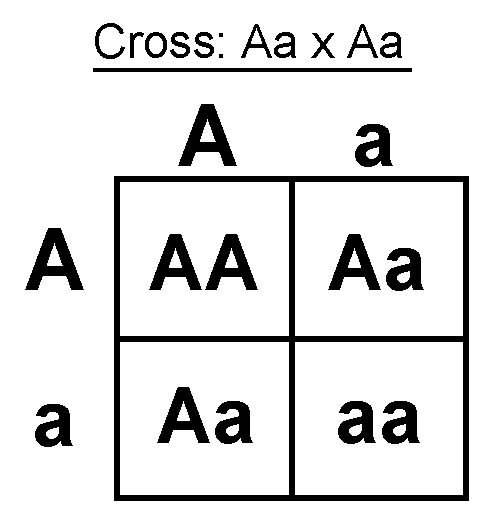
We also learned how to solve genetics problems. Here are the steps:


  1. Write down the info. For example, Dominant=A=trait.
  2. Parenting genotype. Aa x Aa.
  3. Law of segregation. For example, Aa splits up into A and a.
  4. Punnett square. See example on the left.
  5. Fill in the square. Below the empty is one that is filled in.
  6. Create your ratios. For example, on the right, the phenotype ratio is 3 dominant :1recessive. The genotype ratio would be 1AA:2Aa:1aa.


Friday, November 1, 2013

Day 20-Handy Genes

Summary for Your Inner Fish CH3

Although it is interesting that we can trace homologous structure back to common ancestors, it is very interesting that we can trace back the gene frequencies, finding the small changes which result in easily visible differences between species today. Our bodies are formed from one single cell, which carries the plans for our entire body. Within this cell is all of the DNA which is passed from our parents, from their parents and so on. DNA makes up genes, which make up chromosomes, which make up cells, which turn into a body. Hands are very complex structures, which contain three different dimensions: thumb and pinky side, top and bottom, and tip and base. The million dollar question is what change in DNA causes these differences. The answer lies in the embryo, but is impossible to study this on human embryos, so the answer was chickens. A number of biologists did countless hours of work with chicken eggs to prove that each small change within the embryo causes a major difference in the mature body.

Tuesday, October 29, 2013

Day 19-Jump Into the Gene Pool

Survival of the Sickest Ch.6 Summary:

The first vaccines were discovered by a man named Edward Jenner, an eighteenth century doctor. A common disease was cowpox, which many milkmaids had from being around cows. He found that they were immune to smallpox so he then infected a different group of people with cowpox, and found that they were also immune to smallpox. From here, the first vaccine was born. The word vaccine comes from the Latin word vacca, meaning cow, and the Latin name vaccina, meaning cowpox.

Your body contains 46 chromosomes, 23 from your mother and 23 from your father. Within these, there are around 30,000 genes which are organized based on different traits. Although your body has so many genes, only around 3% are actually functioning. The other 97% though, contains important information about how your body works, unlike the misconception that they are "junk DNA."

A scientist named Barbara McClintock disproved another common misconception about DNA from the early 20th century. Through her research and testing on corn, she found that there are genes, which she called "jumping genes," that copy and paste themselves in different places along the chromosomes. She proved that they  were actually intentional mutations, not just random. She found this because they place themselves in certain, particular places and they are triggered by outside influences. She also found that they jump to certain places more than others and they jumped at times of stress.

Another new finding within DNA and mutations is that mutations actually occur outside the germ line all the time. We had thought previously that mutations occur inside the germ line and they affect the entire population and offspring, but this is not the case. For example, Cancer, "which is uncontrolled cell growth caused by a mutation in the gene that is supposed to control growth of cancerous cells" (Moalem, 144). Of course, some forms of cancer are hereditary, but others are caused by factors outside the germ line such as smoking.